Hidden Fees in LCL Shipping: Every Charge Explained (2026)
Your forwarder quotes you $85 per CBM for an LCL shipment from Shenzhen to Rotterdam. Sounds reasonable. You ship 6 CBM of LED panel components. Quick math: $510.
The invoice arrives six weeks later. The total is $891.
You did not misread the quote. The quote was accurate — for one line item out of nine. The other eight were not mentioned until the cargo was already on the water.
ShipTogether, an LCL container pooling platform built on Trevia Group’s China-Europe freight operations, was built partly because of invoices like this one. We process shipments on the Shenzhen-Rotterdam corridor daily, and we see the same pattern across dozens of forwarder invoices every month. The base rate is real. Everything stacked on top of it is where the money actually goes.
This article breaks down every fee you will find on an LCL freight invoice in 2026, explains what each one covers, which ones are negotiable, and what a transparent total actually looks like.
Why Does the Invoice Never Match the Quote?
The final invoice on an LCL shipment can easily land 50–80% above the quoted ocean freight rate. The exact gap depends on the route, the carrier, the agent structure, and even the commodity — but the pattern is consistent. Most of these charges cover real services. The problem is that many forwarders quote only the ocean freight portion, and everything else shows up later.
Here is what a typical 6 CBM LCL shipment from Shenzhen to Rotterdam looks like when you lay out every line item. These numbers reflect invoices we commonly see on this corridor as of May 2026 — your specific totals will vary depending on carrier, agent, and cargo type.
| Fee | What It Covers | Typical Range (6 CBM) | Negotiable? |
|---|---|---|---|
| Ocean freight (base rate) | Port-to-port cargo transport | $480–$720 ($80–$120/CBM) | Yes — volume dependent |
| Origin CFS fee | Consolidation at origin warehouse | $90–$240 ($15–$40/CBM) | Sometimes |
| Origin THC | Terminal handling at Shenzhen port | $120–$200 (flat) | Rarely |
| Documentation fee | Bill of lading, manifests, customs docs | $50–$100 (flat) | Sometimes |
| BAF (Bunker Adjustment Factor) | Fuel cost fluctuation | 10–25% of ocean freight | No |
| Destination CFS fee | Deconsolidation at Rotterdam warehouse | $90–$210 ($15–$35/CBM) | Sometimes |
| Destination THC | Terminal handling at Rotterdam | $150–$250 (flat) | Rarely |
| Customs clearance | EU import declaration processing | $80–$150 (flat) | Yes |
| Delivery / last mile | Warehouse or door delivery from port | $150–$400+ (distance dependent) | Yes |
Add those up at midpoint estimates and you get roughly $850–$900 total. The original $510 “quote” covered barely half the real cost. The exact split shifts depending on your forwarder’s agent structure and which carrier they book, but the pattern is remarkably consistent.
Here is what matters. None of these charges are fake — CFS warehouses, terminal operators, and customs brokers all do real work and charge for it. But a forwarder who quotes you $85/CBM and leaves out $350 in additional charges is not giving you a quote. That is a teaser price, same as an airline advertising “$49 to Paris” before you add baggage, seat selection, and taxes.
The Six Fees That Catch Importers Off Guard
Not every fee on an LCL invoice is hidden on purpose. Some are genuinely variable — fuel costs move, port congestion changes week to week. But six charges consistently catch importers off guard, even ones who have been shipping for years.
1. CFS fees on both ends. CFS stands for Container Freight Station — the warehouse where LCL cargo gets consolidated (origin) and deconsolidated (destination). You pay for both. Most forwarders include the origin CFS in their quote but leave out the destination CFS. For a 6 CBM shipment on China-Europe, that is $90–$210 that appears only on the invoice.
2. BAF that moves after you book. The Bunker Adjustment Factor adjusts for fuel prices. It is calculated as a percentage of the ocean freight, and it can change between the time you get a quote and the time the vessel departs. In May 2026, with Middle East tensions pushing bunker costs up, BAF on Asia-Europe lanes is running 15–25% — that is $72–$180 extra on a $480 base rate.
3. Demurrage and detention. If your container sits at the port beyond the free storage period — typically 3–5 calendar days — you start paying. Rates vary by port, but at Rotterdam, expect EUR 50–100 per day per container. For LCL, demurrage is usually charged per CBM. Miss a customs clearance deadline or have incomplete paperwork and this fee can double your shipping cost on a small consignment.
4. Peak Season Surcharge (PSS). Carriers impose PSS when demand exceeds capacity, typically July through October on Asia-Europe. In 2025, PSS added $200–$400 per TEU. For LCL shippers, this translates to $15–$30 per CBM — not massive, but it adds up when you are already paying $120/CBM base rate and did not budget for it.
5. Warehousing beyond free days. CFS warehouses at destination offer a free storage window — usually 3 calendar days from container unstuffing. After that, storage fees can hit $5–$15 per CBM per day. A week’s delay while you sort out customs paperwork could cost $210–$630 on a 6 CBM shipment. That is more than the ocean freight itself.
6. The “handling fee” catch-all. This is the vaguest line item on any freight invoice. It covers… handling. Some forwarders use it to pad margin. Others use it for legitimate warehouse labor costs. The problem is you cannot tell which without asking, and by the time you see it on the invoice, the cargo is delivered. Typical range: $30–$80.
How to Read an LCL Freight Quote Without Getting Surprised
Three words: ask for all-in.
That changes the entire conversation. A legitimate all-in quote covers ocean freight, origin charges (CFS, THC, documentation), destination charges (CFS, THC), and customs clearance. The only things genuinely left out should be duties and taxes (depend on your HS code and commodity), last-mile delivery (depends on how far your warehouse is from the port), and insurance (depends on what you are shipping and what it is worth).
Here is a checklist. Before you confirm any LCL booking, ask your forwarder to confirm these seven items in writing:
- Is the ocean freight rate locked, or can it change before departure?
- Are origin CFS and THC included?
- Are destination CFS and THC included?
- Is documentation fee included?
- Is BAF included or quoted separately? If separate, what is the current rate?
- How many free days at destination before storage charges apply?
- What is the total cost per CBM, all-in, from factory to port of destination?
If your forwarder cannot answer all seven in a single email, you do not have a quote. You have a starting number.
In our Shenzhen-Rotterdam operations, we quote all-in to the destination port. The number is higher than the teaser rate you will find on aggregator websites, but it is the number that actually appears on the invoice. No line-item surprises six weeks after you have already committed the cargo.
What “All-In” Actually Costs on China-Europe in 2026
Here is what LCL shipping from China to major European ports costs when you add up every fee — not just the ocean freight headline.
| Route | Base Rate/CBM | Typical All-In/CBM | Notes |
|---|---|---|---|
| Shenzhen → Rotterdam | $80–$120 | $140–$195 | Highest destination THC |
| Shanghai → Hamburg | $85–$125 | $145–$200 | Congestion surcharges common |
| Ningbo → Antwerp | $75–$115 | $135–$185 | Often competitive on CFS |
| Shenzhen → Koper | $70–$110 | $125–$175 | Lower THC, Adriatic routing |
These ranges reflect what we commonly see on these corridors as of May 2026. They include ocean freight, origin and destination CFS, THC on both ends, documentation, and BAF at current levels. They do not include customs duties, insurance, or last-mile delivery — those swing too much by shipment and commodity to quote generically. Carrier choice, contract structure, and even the time of month you book will push your actual numbers around within these ranges.
The Shenzhen-Koper lane tends to run slightly cheaper because Koper has lower terminal handling charges than Rotterdam or Hamburg, and the Adriatic routing avoids some of the congestion surcharges that hit Northern European ports.
One thing to flag: these rates are for standard dry cargo. Hazardous goods, temperature-controlled shipments, and oversized cargo all carry additional surcharges that can add 30–100% to the all-in price.
Why Traditional LCL Pricing Is Structurally Opaque
The real issue with LCL costs is not that forwarders are dishonest. It is that the traditional consolidation model involves too many parties touching the cargo, and each one adds a charge.
Think about the journey. Your shipment goes from factory to an origin CFS warehouse, where a consolidator combines it with other shippers’ cargo — a process that commonly takes 14–21 days. Then it gets loaded, shipped across the ocean, unloaded at a destination CFS, deconsolidated, and finally delivered. That is six to eight handling points, each with its own operator and its own fee schedule. The opacity is structural. It is built into the model.
This is where container pooling offers a genuinely different approach — not because it is magic, but because it reduces the number of handling layers.
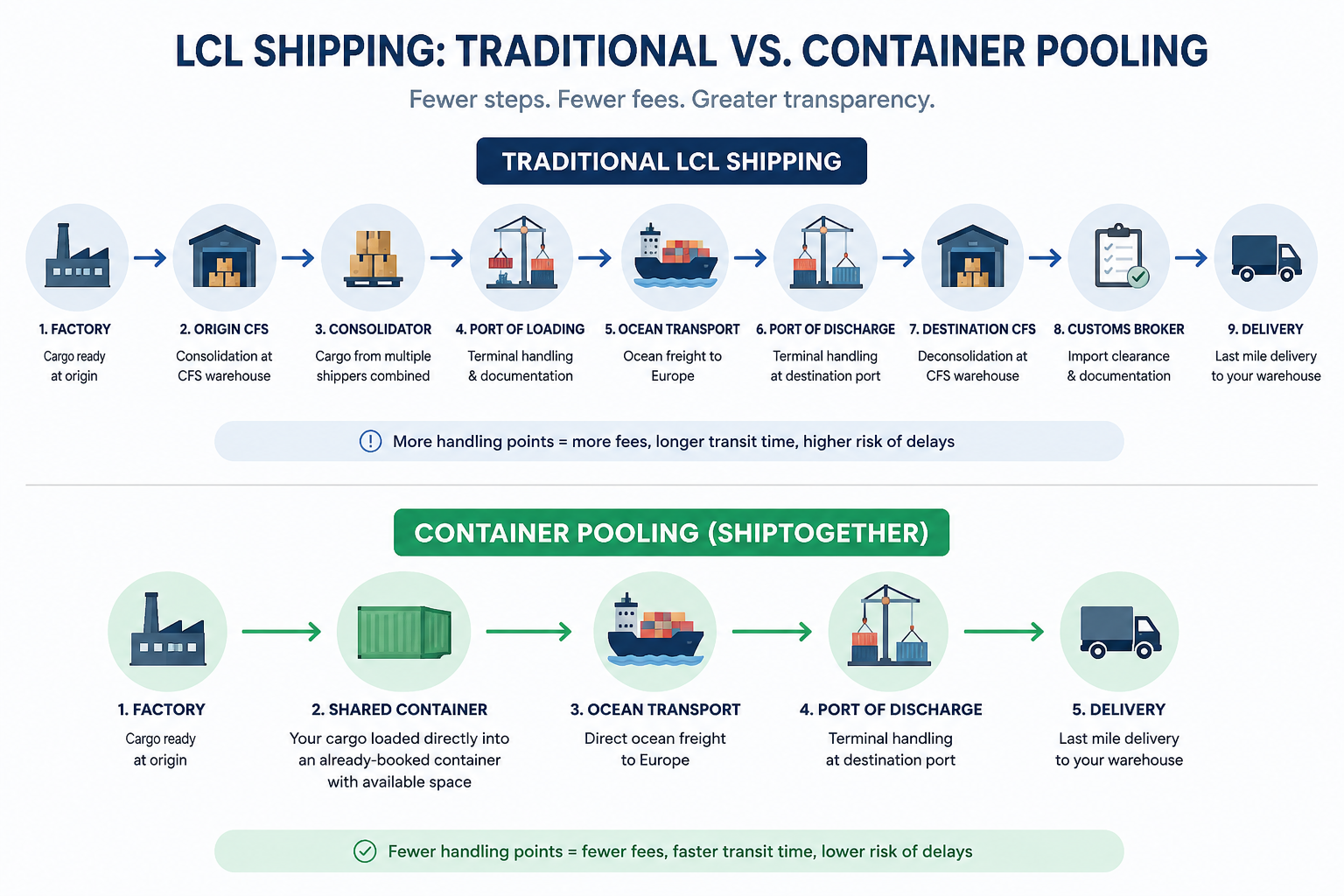
In a pooling model, you join a specific container that a freight forwarder (the organizer) is already sending on your route. They have booked a 20-foot or 40-foot container, have unused space, and you get allocated directly into that container. There is still staging, stuffing, and export processing — cargo does not teleport onto a vessel. But the traditional CFS consolidation and deconsolidation steps are reduced or eliminated, and with them, the associated fees.
Container pooling is not suitable for every shipment. Your timing needs to align with the organizer’s schedule. The route has to match. You need a degree of flexibility on exact departure dates. But on repeat SME corridors with stable, recurring flows — Shenzhen to Rotterdam, Shanghai to Hamburg — it can materially reduce both the handling layers and the pricing opacity.
On the Shenzhen-Rotterdam lane, container pooling through ShipTogether commonly brings the joiner’s port-to-port freight share to EUR 55–67 per CBM (CFS-to-CFS) — roughly 18–25% below the comparable LCL freight rate on a like-for-like basis. As on LCL, destination handling, customs and delivery are paid separately by the importer. The gap is not because pooling is subsidized; it is because fewer parties handle the cargo.
| Factor | Traditional LCL | Container Pooling |
|---|---|---|
| Typical rate/CBM | EUR 120–180 (all-in) | EUR 55–67 (freight share) |
| Fill time | 14–21 days | 4–7 days |
| Handling layers | 6–8 | 4–5 (reduced CFS handling) |
| Fee structure | Base rate + 5–8 surcharges | Single rate + fixed coordination fee per CBM |
| Demurrage risk | Higher (longer CFS dwell) | Lower (shorter staging window) |
| Tradeoff | Flexible timing, any volume | Route must match, some schedule flexibility needed |
The bottom row matters. If you need to ship 2 CBM of samples to a port that only sees one container a month, traditional LCL is still your best option. Container pooling works best when the corridor has regular volume and you are shipping enough CBM to justify the organizer accepting your cargo into their container.
Frequently Asked Questions
What are the hidden fees in LCL shipping?
The most common hidden fees are origin and destination CFS (Container Freight Station) charges, terminal handling charges (THC) at both ports, Bunker Adjustment Factor (BAF) surcharges, documentation fees, and warehousing charges beyond the free storage period. Together, these often add 50–80% on top of the base ocean freight rate — the exact gap depends on route, carrier, and agent structure.
How much does LCL shipping from China to Europe actually cost per CBM?
The base ocean freight rate for LCL from China to Europe in 2026 runs $75–$125 per CBM depending on the route. But the all-in cost — including CFS, THC, BAF, and documentation — is $125–$200 per CBM. The Shenzhen-Rotterdam corridor sits at approximately $140–$195/CBM all-in, while Shenzhen-Koper is slightly cheaper at $125–$175/CBM.
Why is my LCL freight invoice higher than the original quote?
Most forwarders quote only the ocean freight portion of LCL shipping. The invoice includes additional charges for container freight station handling, terminal handling, fuel surcharges, and documentation that were not part of the original quote. Always ask for an all-in quote that specifies every charge from origin to destination port before confirming a booking.
What is a CFS fee in freight shipping?
CFS stands for Container Freight Station — the warehouse where LCL (Less than Container Load) cargo is consolidated at origin and deconsolidated at destination. CFS fees cover the labor and space required to load your cargo into a shared container and unload it at the other end. On China-Europe lanes, CFS fees typically run $15–$40 per CBM at each end, adding $30–$80 per CBM total to your shipment cost.
Is container pooling cheaper than traditional LCL?
On established corridors with regular volume, often yes. Container pooling reduces the CFS handling layers that add significant cost to traditional LCL. On the China-Europe corridor, pooling commonly brings the joiner’s port-to-port freight share to EUR 55–67 per CBM (CFS-to-CFS) — roughly 18–25% below the comparable LCL freight rate on a like-for-like basis, with destination handling, customs and delivery paid separately by the importer, as on LCL. The savings come from fewer handling points and a simpler fee structure. The tradeoff is that your route and timing need to match an available container — pooling works best for repeat shipments on popular lanes, not one-off moves to niche ports.
What To Do Next
If you are shipping 3–15 CBM per shipment from China to Europe, you have three options: pay traditional LCL rates with their hidden fee stack, book a full container you will not fill, or join a container pool and pay for exactly the space you use.
ShipTogether’s Founding Shippers program is open to SME importers on the China-Europe corridor. You see the full cost before you commit, the coordination fee is fixed per CBM (see current rate), and there are no CFS handling surprises on the invoice.
See how container pooling works →
Related reading:
Built on Trevia Group’s China-Europe freight operations.