The real cost of half-empty containers
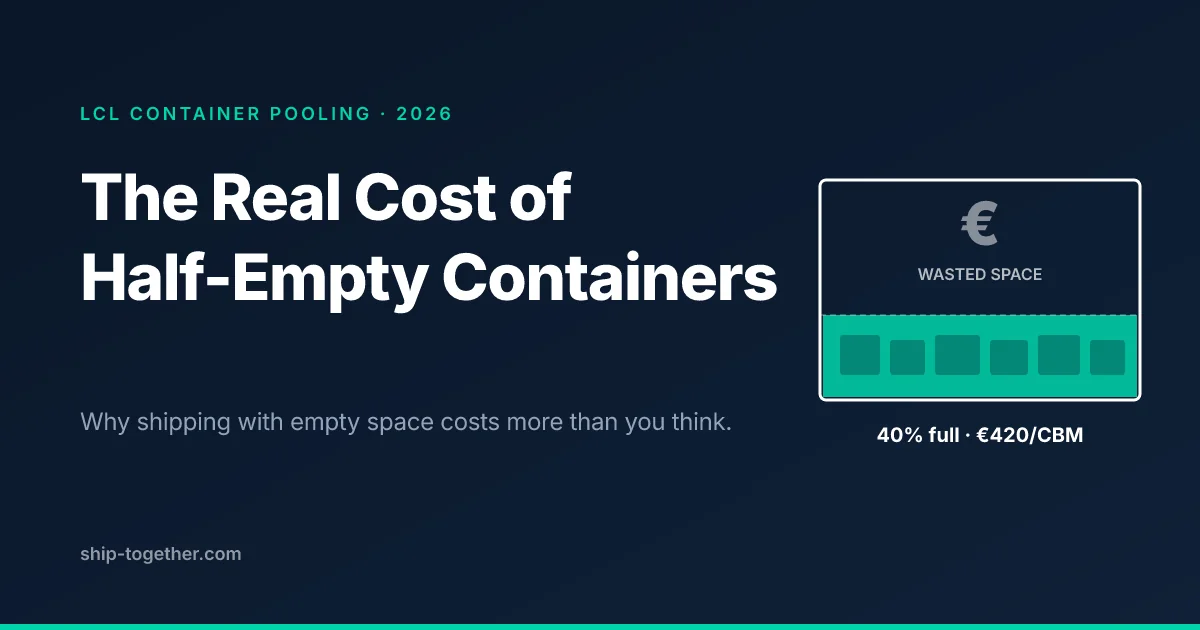
A standard 40-foot high-cube container holds about 67 cubic meters of cargo. But many importers — especially small and mid-sized businesses — need only 5 to 15 CBM per shipment. When they book a full container, they're paying for space they don't use.
This isn't a niche problem. It's how a significant portion of global trade actually works.
The two options small importers have today
Option 1: Book a full container (FCL). You get the whole box. It ships on your schedule. Customs clearance is straightforward because everything in the container is yours. The downside: you're paying for 67 CBM when you only need 10. For many small importers, this makes certain products uneconomical to import.
Option 2: Use a consolidator (LCL). Less-than-container-load shipping means your goods share a container with other shippers' goods, managed by a freight consolidator. You pay per CBM, which sounds ideal. In practice, LCL has real drawbacks:
- Unpredictable timing. The consolidator waits until the container is full before shipping. If volume is low, your goods sit in a warehouse.
- Higher handling. Your goods are loaded, unloaded, and reloaded at the consolidation and deconsolidation warehouses. More handling means more risk of damage.
- Opaque pricing. LCL rates often include surcharges that aren't visible upfront: CFS charges, terminal handling, documentation fees.
- No control. You don't know who else is in the container or what they're shipping. You have no relationship with the other shippers and no say in scheduling.
A third option: shared container pools
The idea behind ShipTogether is simple. Instead of a consolidator deciding when and how your goods ship, a small group of importers coordinates directly to fill a container together.
Each importer books the CBM they need. The platform handles the coordination: matching compatible cargo, managing the booking timeline, splitting costs proportionally. The container ships when it's full — but because the pool is purpose-built for a specific route with a known departure window, fill times are more predictable than traditional LCL.
The key differences from LCL:
- You see who's in the pool and what's being shipped.
- Pricing is transparent: your share of the container cost plus a fixed coordination fee per CBM. Current rate.
- The departure schedule is set upfront, not determined by when the consolidator happens to fill the box.
This isn't a new idea
Importers have been informally sharing containers for decades. Business owners in the same industry or region will coordinate over email or WhatsApp to fill a box together. It works, but it doesn't scale. Finding partners for every shipment takes time, and there's no standard process for splitting costs, handling documentation, or resolving disputes.
ShipTogether is the structured version of what already happens informally. A platform that makes shared containers reliable enough to use regularly.
We're starting with one route — Shanghai to Rotterdam — and we're looking for importers who want to try it.