FCL vs LCL Cost Comparison 2026: What EU Importers Actually Pay
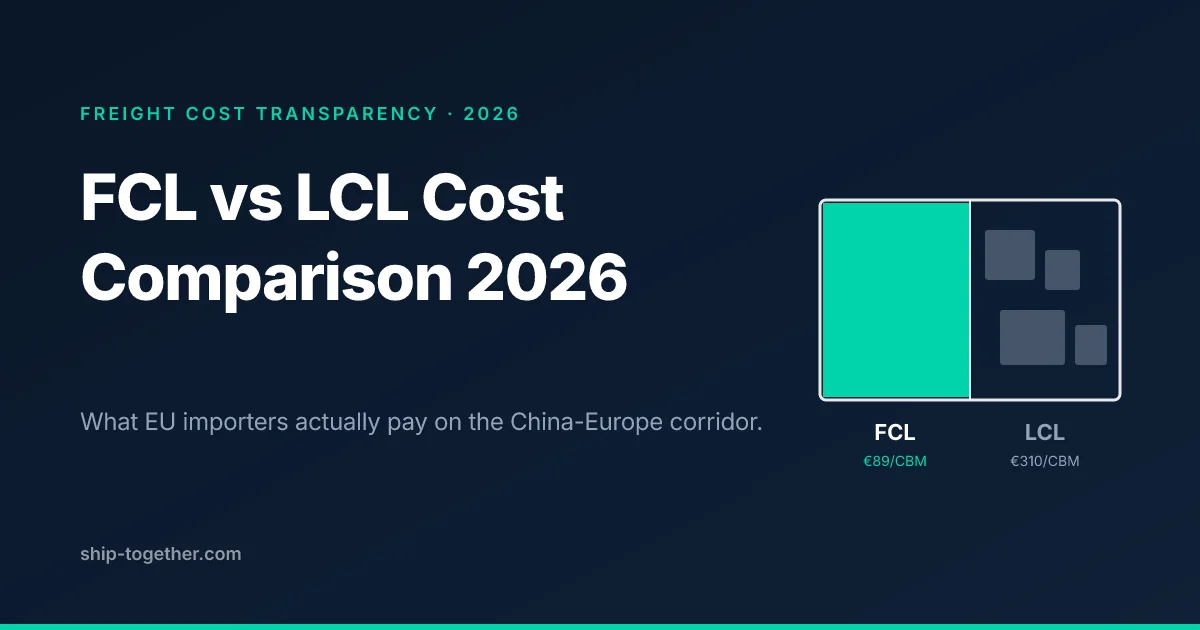
An EU importer shipping 6 CBM from Shenzhen to Rotterdam sees a headline LCL rate of about EUR 225 per CBM — but pays closer to EUR 310 per CBM once documentation, handling and customs are stacked on. That gap between the quote and the invoice is what makes the FCL vs LCL decision worth getting right in 2026.
Most guides on this topic give you a formula and tell you to do the math. That is not what this article does. ShipTogether ships containers on the China-Europe corridor every week, and the numbers below come from real quotes and real invoices — not rate card averages from 2023.
Here is what you actually pay for FCL and LCL in 2026, where each one makes sense, and a third option that most importers have not considered.
What Does LCL Shipping from China to Europe Cost in 2026?
LCL rates from China to Europe currently sit at EUR 200–250 per CBM through traditional consolidators, with EUR 225/CBM as the most common quote on the Shenzhen-Rotterdam lane. But that headline rate is misleading — it does not include the charges that make LCL expensive.
The real cost of an LCL shipment includes the ocean freight per CBM, plus a documentation fee (EUR 35–75), a consolidation fee (EUR 25–50 per shipment), a destination handling charge (EUR 40–80 per CBM), a minimum bill of lading charge (many consolidators set a floor at 2–3 CBM regardless of actual volume), and customs clearance at destination.
Based on ShipTogether’s operational data from the China-Europe corridor, a typical 6 CBM LCL shipment from Shenzhen to Rotterdam breaks down like this:
| Cost Component | Amount |
|---|---|
| Ocean freight (6 CBM × EUR 225) | EUR 1,350 |
| Documentation fee | EUR 50 |
| Consolidation fee | EUR 40 |
| Destination handling (6 × EUR 50) | EUR 300 |
| Customs clearance | EUR 125 |
| Total landed cost | EUR 1,865 |
That works out to roughly EUR 310 per CBM all-in — significantly more than the EUR 225 headline rate.
LCL also comes with a time penalty. Traditional consolidators warehouse cargo for 14–21 days while they fill the container. That is two to three weeks of inventory sitting in a shed before it even gets on a ship.
What Does FCL Shipping from China to Europe Cost in 2026?
A 20ft FCL container from Shenzhen to Rotterdam runs EUR 1,800–2,400 in Q2 2026, depending on the carrier and booking lead time. A 40ft container sits at EUR 2,800–3,600. These rates are well below the 2021–2022 peak but have firmed up from the 2023 lows.
FCL pricing is simpler than LCL. You pay for the full container regardless of how much you put in it. Documentation, terminal handling, and customs clearance add EUR 300–500 on top, but there is no per-CBM multiplication.
The math gets straightforward: a 20ft container holds approximately 28–33 CBM of cargo. If you fill it to 28 CBM and your all-in FCL cost is EUR 2,500, your effective rate is EUR 89/CBM. Compare that to the EUR 310/CBM all-in LCL rate and the difference is dramatic.
The problem, obviously, is that most SME importers cannot fill 28 CBM every shipment.
Where Is the Breakeven Between FCL and LCL?
The breakeven point — where FCL becomes cheaper than LCL per CBM — depends on the specific rates you are getting, but on the China-Europe corridor in 2026, the math typically works like this:
FCL becomes cheaper than LCL at roughly 10–12 CBM on the Shenzhen-Rotterdam lane.
Here is the calculation with current rates:
| Volume | LCL Cost (all-in) | FCL Cost (20ft, all-in) | Cheaper Option |
|---|---|---|---|
| 3 CBM | ~EUR 930 | EUR 2,500 | LCL |
| 6 CBM | ~EUR 1,865 | EUR 2,500 | LCL |
| 10 CBM | ~EUR 3,100 | EUR 2,500 | FCL |
| 15 CBM | ~EUR 4,650 | EUR 2,500 | FCL |
| 20 CBM | ~EUR 6,200 | EUR 2,500 | FCL |
| 28 CBM (full) | ~EUR 8,680 | EUR 2,500 | FCL |
The catch is clear: if you are shipping between 3 and 9 CBM — which a large share of mid-market EU importers do — you are stuck paying the LCL premium because you cannot justify a full container.
This is the gap where a third option becomes relevant.
The Third Option: Shared FCL (Container Pooling)
Container pooling — also called shared FCL — works like this: a freight forwarder books a full container and opens part of the space to other shippers. Each shipper pays a share of the FCL rate proportional to their CBM, plus a small coordination fee.
ShipTogether, a container pooling platform for SME importers, operates on this model. A joiner pays their port-to-port freight share — about EUR 55–67/CBM (CFS-to-CFS) plus a fixed coordination fee — and, as the importer of record, pays destination handling, customs and delivery separately, the same line items an LCL consolidator bundles into its invoice.
Compared like-for-like — freight against freight, on a CFS-to-CFS basis, before the destination handling and customs both importers pay — ShipTogether’s operational data puts the joiner’s saving at roughly 18–25% versus standard LCL freight. The container fills in 4–7 days on average, compared to the 14–21 day warehouse wait with traditional LCL consolidators.
Here is the updated comparison with shared FCL included:
| Volume | LCL (all-in) | FCL (20ft) | Shared FCL | Best Option |
|---|---|---|---|---|
| 3 CBM | EUR 930 | EUR 2,500 | EUR 250 | Shared FCL |
| 6 CBM | EUR 1,865 | EUR 2,500 | EUR 500 | Shared FCL |
| 10 CBM | EUR 3,100 | EUR 2,500 | EUR 800 | Shared FCL |
| 15 CBM | EUR 4,650 | EUR 2,500 | EUR 1,200 | FCL or Shared FCL |
| 20 CBM | EUR 6,200 | EUR 2,500 | EUR 1,600 | FCL |
Shared FCL is cheapest up to about 15 CBM. Above that, booking your own FCL makes more sense since you are filling most of the container anyway. The shared-FCL figures above are the port-to-port freight share; as on LCL, the importer pays destination handling, customs and delivery on top — so the like-for-like saving versus LCL freight is about 18–25%.
When LCL Still Makes Sense
LCL is not always the wrong choice. It makes sense when you are shipping very small volumes (under 1 CBM), when you need door-to-door service from a consolidator who handles everything, when speed matters less than convenience, or when you are testing a new product and want to ship a sample-sized batch without committing to a container share.
For regular shipments above 2–3 CBM on a repeating route, LCL is almost always the most expensive option per CBM.
When FCL Makes Sense
FCL is the right call when you can consistently fill 15+ CBM, when you need the full container for a single SKU or sensitive cargo that should not share space, or when you ship on a fixed schedule and can plan inventory around container departures.
The ideal FCL shipper fills 20–28 CBM reliably. Below that, you are paying for empty space — which is exactly the problem container pooling solves.
How to Decide: A Practical Framework
Forget the formulas. Here are three questions that cut through the noise:
1. How much cargo do you actually ship per month on this route?
Under 10 CBM regularly → shared FCL saves you the most. Over 15 CBM regularly → book your own FCL. In between → compare shared FCL and FCL quotes for your specific lane.
2. How sensitive is your cargo to timing?
If an extra 3–5 days of wait kills your inventory plan, skip LCL entirely. Shared FCL fills in 4–7 days. FCL ships on your schedule. LCL warehouses for 14–21 days before departure.
3. What is your true all-in LCL cost?
Add up every line item on your last three LCL invoices. Most importers underestimate their LCL cost by 25–40% because they do not account for destination handling, documentation, and minimum charges. The real number is usually what makes the FCL or shared FCL case obvious.
Frequently Asked Questions
How much does LCL shipping from China to Europe cost per CBM in 2026?
LCL shipping from China to Europe costs EUR 200–250 per CBM for the ocean freight component in 2026. However, the all-in cost including documentation, consolidation, and destination handling fees typically runs EUR 280–350 per CBM. On the most common lane (Shenzhen to Rotterdam), the average all-in LCL cost is approximately EUR 310 per CBM based on current market rates.
At what volume does FCL become cheaper than LCL?
On the China-Europe corridor in 2026, FCL becomes cheaper than LCL at approximately 10–12 CBM. A 20ft FCL container from Shenzhen to Rotterdam costs EUR 1,800–2,500 all-in, while LCL at the same volume (10 CBM × EUR 310/CBM all-in) costs roughly EUR 3,100. Below 10 CBM, container pooling (shared FCL) offers the best per-CBM rate at EUR 55–67/CBM.
What is container pooling and how does it compare to LCL?
Container pooling (also called shared FCL) is a shipping method where multiple shippers share space in a single full container, each paying a proportional share of the FCL rate. Where traditional LCL consolidation warehouses cargo for 14–21 days, container pooling fills containers in 4–7 days. The joiner pays their port-to-port freight share — about EUR 55–67/CBM (CFS-to-CFS), roughly 18–25% below the comparable LCL freight rate on a like-for-like basis — then, as importer of record, pays destination handling, customs and delivery separately. ShipTogether operates as a peer-to-peer container pooling platform on the China-Europe corridor.
How long does LCL consolidation take compared to FCL?
Traditional LCL consolidators warehouse cargo for 14–21 days while filling the container, then add 25–35 days of ocean transit for a total of 40–56 days origin to destination. FCL containers ship on the next available sailing (typically within 3–7 days of booking) with 25–35 days ocean transit. Shared FCL through container pooling platforms like ShipTogether fills in 4–7 days, making it nearly as fast as booking your own FCL.
Should I switch from LCL to FCL for my China-Europe shipments?
If you ship 15+ CBM regularly on the same route, switching to FCL will save you 50–70% compared to LCL. If you ship 3–12 CBM, full FCL is too expensive but shared FCL (container pooling) can save roughly 18–25% on a like-for-like CFS-to-CFS basis versus LCL freight. Only stick with LCL if you ship under 2 CBM per shipment, need maximum flexibility, or are testing a new route with sample quantities.
What To Do Next
Shipping 3–15 CBM from China to Europe? Check current shared FCL rates on ShipTogether and see what you would save compared to your last LCL invoice. The coordination fee is fixed per CBM, you see the full cost before you commit, and there are no CFS handling surprises on the invoice.
See how container pooling works →
Related reading:
Built on Trevia Group’s China-Europe freight operations.